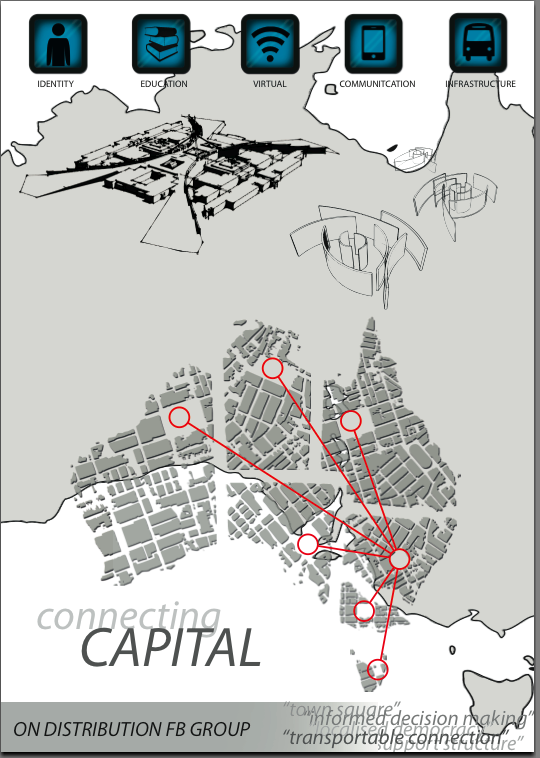
the project has run very smoothly and it has developed into a gem - for the structure of the strategy it really captures what the australian lifestyle is all about. development is key for a country will vast ranges of infrastructure, telecommunication, education and identity. it can encourage us to be more interactive through passive architectural design for our everyday lives.
"VOTE THEN………..WAIT……….?
What if your opinion counted more than once every 4 years?
The location of parliament in Canberra, separated from the large majority of Australia’s population has created a Government power, disconnected from the public it is nominated to serve.
The current Parliamentary infrastructure is a maze of chambers and offices where politicians delegate decision making into committees, whose role it is to engage with the public to gain opinions and report back to the politicians. How can this engagement occur in the 21st century in which the dominant urban infrastructure is information “soft” technology? Can the power to control decisions be distributed back to the community?
Despite the rise in telecommunication, people ultimately require physical interaction and creating a space where these two functions can intersect is essential. Re-appropriating public space and urban infrastructure is the solution.
By doing so, a means for public interaction, voicing of opinions and voting can be facilitated publicly around all Australian capital cities. This will be achieved by allocating prominent public city spaces nationwide to provide these facilities, thereby creating an active political information network across Australia, which will link back to the existing parliament house in Canberra.
The proposed architectural entity contains 5 key elements – symbolic of parliamentary functions, which are:
1. Communication
2. Education
3. Infrastructure
4. Virtual Element
5. Identity
Interactive screens allow people to communicate and participate in national issue discussions, and the information sharing is collected into a national database. This digital infrastructure will also serve as a public education tool, and the physical presence and location across Australian cities creates an entity that encourages the public to engage with. The locality of the screens direct people through the space in a formal manner just as the formal orientation of Capital Hill is positioned through to Landscaped views.
The history of parliament originated with people gathering in public spaces to discuss issues relevant to the community. The growing global population has increased the amount and complexity of societies’ issues yet not decreased the need for people to be involved in the solutions. The people are just waiting for a platform to voice their opinions.
DON’T WAIT!
HAVE YOUR VOICE HEARD NOW!"
it was really hard to conceptionalize the ability of the government and how you and me as young individuals barely affected by these policies and legislation or whether generation y are just ignorant. bringing the history back into modern society it can encourage interaction with all classes of statue within the community. will this strategy work - in my opinion it has the ability to change the way we interact with each other and our community.